A deaerator is a device that removes oxygen and other dissolved gases from liquids. Dissolved oxygen in feedwater will cause serious corrosion damage in a boiler by attaching to the walls of metal piping and other equipment and forming oxides (like rust)..
Likewise, people ask, how does a deaerator system work?
Deaerators are mechanical devices that remove dissolved gases from boiler feedwater. Deaeration protects the steam system from the effects of corrosive gases. It accomplishes this by reducing the concentration of dissolved oxygen and carbon dioxide to a level where corrosion is minimized.
One may also ask, why deaerator is used in boiler? The purpose of a deaerator is to reduce dissolved gases, particularly oxygen, to a low level and improve a plant's thermal efficiency by raising the water temperature. In addition, deaerators provide feedwater storage and proper suction conditions for boiler feedwater pumps.
Besides, how does a deaerator remove oxygen?
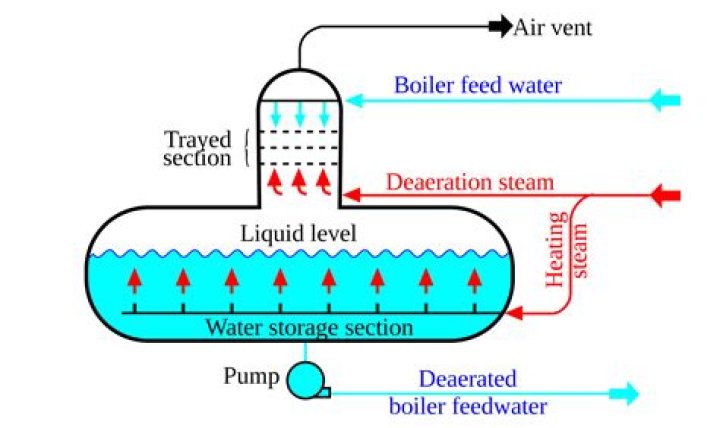
A deaerator utilizes both of these natural processes to remove dissolved oxygen, carbon dioxide and other non-condensible gases from boiler feedwater. The feedwater is sprayed in thin films into a steam atmosphere allowing it to become quickly heated to saturation.
Why deaerator is placed at height?
Explanation: Deaerator is installed at a certain height from the pump so as to maintain a optimum pressure before suction. Explanation: The feedwater heaters after the deaerator are often called low pressure heaters(l.p.).
Related Question Answers
How many types of deaerators are there?
There are two main types of boiler deaerators: tray-type, or cascade-type deaerators, and spray-type deaerators. The tray type features a vertical section that is domed and mounted to the top of a horizontal tank that stores the water for the boiler.How do you make deaerated water?
The simplest is boiling the water, as oxygen has very low solubility in hot water. “Scrubbing” of the water with oxygen-free CO2 or nitrogen is another method, and finally applying a vacuum to water trickling over a large surface (often in a hollow tube filled with small “fillers”) can also be applied.How is oxygen removed from water?
This is possible using a process known as electrolysis, which involves running a current through a water sample containing some soluble electrolyte. This breaks down the water into oxygen and hydrogen, which are released separately at the two electrodes.What is de aeration?
Deaeration is the removal of air molecules (usually meaning oxygen) from another gas or liquid. It can refer to: Use of a deaerator. Degasification, the removal of dissolved gases, such as oxygen, from liquids.What is deaerated water?
Deaeration is the removal of dissolved or entrained gases from water to be used as boiler feed or for other processes. Oxygen and carbon dioxide present in untreated water cause corrosion of the usual boiler and steam plant materials.How do you spell deaerator?
verb (used with object), de·aer·at·ed, de·aer·at·ing. to remove air or gas from. to remove bubbles from (a liquid, as boiler feedwater), as by mechanical agitation in a vacuum or by heating at atmospheric pressure.Is a deaerator a pressure vessel?
Deaerators are large, insulated tank-car-shaped pressure vessels. They produce preheated boiler feedwater to help ensure efficient steam-plant operation. Deaerators come in numerous sizes and shapes, depending on boiler-plant design, capacity, and system pressure rating.What is the purpose of a boiler?
Combustion Training A boiler is an enclosed vessel in which water is heated and circulated, either as hot water, steam, or superheated steam for the purpose of heating, powering, and/or producing electricity.What is oxygen scavenger in boiler?
The Oxygen Scavenger is used for removing oxygen from boiler feed water straight away. This catalyzed scavenger converts itself to sodium bisulfate and remove oxygen instantly from boiler feed water. It is also responsible for buffering pH and reducing alkalinity of the feed water.What is pegging in deaerator?
What is pegging in deaerator? basically the pegging steam is used to create a scrubbing action between the steam and the feedwater, by which we can eliminate the dissolved corrosive gases mainly oxygen, co2, and ammonia which becomes corrosive at elevated temperatures.How does a vacuum deaerator work?
In a vacuum deaerator, water flows by gravity down through a tower filled with packing as a vacuum is drawn on the tower. The packing in the tower has a very high surface area, disperses the water very effectively, thereby enhancing the removal of O2, CO2 and N2.What is deaerator pegging?
A deaerator is typically a counterflow design that facilitates greater contact of the steam to the water, efficient heating and vigorous scrubbing of the water with the steam. Pegging steam, as it's referred to in this application, is used for mechanical pressure deaeration.Where are the dissolved gases removed from the deaerator?
The dissolved gases are stripped from the water through a combination of steam, heat, and mechanical separation in the deaerating section. The deaerated water flows to the storage section where it is held as boiler feedwater.Why do we treat boiler water?
Boiler water is treated to prevent scaling, corrosion, foaming, and priming. Chemicals are put into boiler water through the chemical feed tank to keep the water within chemical range. Scale is precipitated impurities out of the water and then forms on heat transfer surfaces.Why is a boiler blowdown necessary?
Boiler blowdown is the removal of water from a boiler. Its purpose is to control boiler water parameters within prescribed limits to minimize scale, corrosion, carryover, and other specific problems. Blowdown is also used to remove suspended solids present in the system.How does a superheater work?
A superheater is a device used to convert saturated steam or wet steam into superheated steam or dry steam. Superheated steam is used in steam turbines for electricity generation, steam engines, and in processes such as steam reforming. There are three types of superheaters: radiant, convection, and separately fired.Why are phosphates added to a boiler?
When a significant excess of soluble orthophosphate and free hydroxide (caustic) alkalinity is maintained in the boiler water, calcium carbonate formation can be virtually eliminated.Polymeric dispersants or sludge conditioners are added with the phosphate to condition the sludge for improved removal from the boiler.What is TDS in boiler water?
Total Dissolved Solids (TDS) are the impurities in boiler feed water that reduces the heat transfer rates, increase scale deposits, increase heat losses thereby reducing the boiler efficiency. Total Dissolved Solids (TDS) comprises of both Suspended and Dissolved Solids.Why is the pH in my boiler water high?
Oxygen dissolved in water is essential for the cathodic reaction to take place. Second common cause of corrosion in boiler systems is low pH within the boiler. This reduced pH may result from CO2 infiltration or form contamination by other chemicals. pH of 9 could be used in higher pressure boilers.